Casus Belli: Latin expression meaning “An act or event that provokes or is used to justify war.”
When I was outlining the story arc for the TCOTU series, I knew that Heskan and crew would be leaving the Republic. The question was, where would they go? As a former military service member, I thought it would just be too unrealistic for them to settle down in the territory of their age-old enemy. That ultimately left two places: The Solarian Federation or one of the corporate systems.
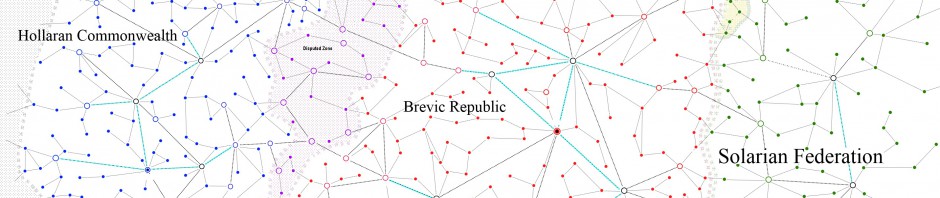
I chose a corporate system because it offered me an opportunity to shake off some of the paradigms that had been constructed by focusing solely on the major powers. The Brevic Republic, the Hollaran Commonwealth, the Solarian Federation… sure, they have different ideologies and their own idiosyncrasies, but they are ultimately similar when it comes to how they wage war. Corporate systems, with their limited resources, would have to approach conflict from a very different angle.
Those differences provide quite a culture shock for Heskan (and hopefully the reader) and are part of what makes the final two books interesting. This series is about people and cultures. If the “problem” is defeating an enemy fleet, you’d see different “solutions” when looking at how the different cultures would go about defeating that fleet.
Inventing the corporate way of war was a lot of fun. I knew, immediately, that I wanted it to be filled with rules and scriptures that would seem a little crazy to someone from a culture that engaged in a “total war” theory. This brought about the notion of the necessity of having a casus bellum recognized before some third party (“The Courts”) before a corporation could actually engage in war. I also wanted actual combat to be about resolving the conflict with as little loss of resources as possible. After all, corporations are about profit and why bother fighting a war that costs you everything, even if you win. Outsourcing some of the fleet (i.e., the privateers) seemed reasonable.
While brainstorming how a corporate battle would work, I realized that since battles really weren’t that blood-filled and happened only rarely (relatively speaking), they would be an enormous spectacle… one that any sensible corporation would capitalize on. Hence, the battlefields would become a circus-like atmosphere with spectators. This actually follows American history. Hundreds of spectators lined up in the early morning of a July Sunday in 1861 to watch one of the opening battles (First Manassas, better known as The First Battle of Bull Run) in the American Civil War:
“They came in all manner of ways, some in stylish carriages, others in city hacks, and still others in buggies, on horseback and even on foot. Apparently everything in the shape of vehicles in and around Washington had been pressed into service for the occasion.” — From “Spectators Witness History at Manassas” at civilwar.org
But war would be a last resort for the corporate systems. After all, they are expensive (and messy). A corporation would more often attempt alternate methods of securing its goal before resorting to something as costly and dangerous as going to war. The reader will see this point brought home early in the next series.
 This Corner of the Universe